So this blog is long, but describes in pretty good detail our 2nd full day at our post in the Dosso region of Niger... enjoy :)
Our 2nd day at post was definitely overwhelming. We woke up after a much better sleep than the 1st night, and about 20 minutes later, there was a knock on our gate from a man inviting us to a naming ceremony that was happening "yanzu" (or "now" in English). So we hurried up and got ready, then walked into the main square in town to buy and eat a quick breakfast of fried dough (fari masa).
Then came the first task: trying to locate where the naming ceremony was by asking random people about it. So we asked around and they said they didn't know of a ceremony in Fadama (our village). So we made our way to the mayor's house to ask him. He kindly asked an elderly man walking by to show us where it is, and we started to follow him. We walk up a hill, and enter a household where we greet a man and his family, except it is not really a ceremony; with just a few women gathered near a hut and the father sitting nearby. But the family had clearly recently had a birth, so we gave the man our gift of a bar of soap, greeted him on the birth (barka da haihua), and then followed our guide back out to the street, wondering where the ceremony was that we had actually been invited to.
But we needn't have worried. Our elderly guide made it clear we were still supposed to follow him and soon we found ourselves at another house which had 3 or 4 ox carts and a car outside. We gathered through our limited language skills that we were supposed to wait a few minutes for the people to get ready, then mount a cart that would take us to the ceremony. After a few minutes, we were shown to a cart, and, after assuring the concerned onlookers that we would in fact be just fine on an ox cart instead of needing to ride in the car, we got on. All the while we still thought the ceremony was perhaps just across town and for some reason everyone wasn't walking but instead riding ox carts.
However, it turns out that the ceremony was in fact not in Fadama at all, but in Sabon Gari (literally - new village), which is about 4-5 kilometers South. This slowly dawned on us as we watched Fadama slowly disappear behind us and the bush of Niger extending out into the distance. We rolled through thick sand as we passed trees and fields and other people walking along the road.
The countryside was beautiful: barren fields dotted with trees and bushes, with a low mesa creating a break in the otherwise flat horizon to the SouthWest. A Baobob tree, with its massive trunk making its tiny, twisted branches look out of proportion, acted as a landmark about half the way to Sabon Gari. After about 45 minutes our arrival in the village was marked by the appearance of mud walls surrounding mud huts, slowly closing in on the sandy trail we were rolling along. The convoy of 3 ox carts from Fadama stopped at the intersection of two dirt roads and all the passengers, including us, plopped down and milled around for about 5 minutes, which was apparently too long for us anasaras (white people) to stand up, because a man brought over a wooden bench for us to sit on. We felt ridiculous as we sat down in the middle of all the standing people, but thankfully, a man took pity on us and sat down with us. I asked him his name and he said it was Isa before saying that we had met the day before and that I had forgotten already... oops.
Suddenly, by some unspoken signal, everyone started walking Westward down a street flanked by mud brick walls in varying degrees of disrepair from the battering of rainy seasons past. After only a couple hundred yards the South wall gave away to a large square-ish place were 100 or so people were gathered, sitting atop mats on the ground, shaded by three large trees. We were still walking with Isa and by now realized that Ash is the only woman in sight, apparently we had missed the memo about where all the women were gathering, so we decided to just go with it until someone told us to separate. Isa showed us to an empty space on a mat and we sat and greeted the men around us.
Almost immediately a man appeared with a chair and a promise of another for us to sit in and after kindly waiting for us to try to explain that we are fine sitting on the mat, insisted anyway that we needed to sit in the chairs. Men were making rounds to greet everyone and Isa came over again to tell us we should go greet the father of the baby and pointed to an area under a tree where ten or so men were sitting. So we walked over and decided to greet them all since we had no idea who in fact was the father.
The ceremony was short, consisting of the Imam chanting prayers and random "Amins" popping out of the men surrounding him. After we had all repeated three times, on the Imam's signal, bringing both hands to cover our eyes, then touching our chest, the ceremony ended and we stood to greet our neighbors before our ox cart driver, Garba, came over and said we would be leaving right after we went and greeted someone who was mourning a death.
We were surprised that we'd be heading back so soon, having given up on any other plans we had had the moment we left Fadama that morning. So we followed Garba, winding our way through the sandy, slightly hilly village to find the man we were supposed to greet. The process of mourning in Niger (which from what I understand is more closely a result of Islam than of specific Nigerien traditions) is fascinating. After news of one's death, his/her family goes into a period of mourning for one week. From the two that we've observed and from cultural training, it seems as if the men in the family (usually the father of the deceased or the oldest male) stops all work, prepares mats in a shady spot, and sits all day long as people come to greet him on the death. Some visitors stay all day, just chatting or sitting in silence, while others (like us on the naming ceremony day), will just come up, sit and greet him, say some blessings, wait for a moment in silence, then get up and go on their way.
Apparently Garba had told his son to ready the oxen and start heading back because we took a different route back down through the village and spotted to ox carts waiting for us a hundred yards passed the last hut. Down the road, just passed the amazingly large Baobob tree, we start seeing groups of kids walking back towards Sabon Gari from Fadama. We ask Garba what they were doing and were told that although there is a primary school (similar to our elementary schools) in Sabon Gari, if the students want to continue to colege (equivilant to our middle schools), they had to walk back and forth to Fadama everyday.
As we rolled back into Fadama, the people on the streets waved and greeted us, saying "you came back!" or "you went to the place of the ceremony, right?" We finally come to a jerky stop back where we started and were asked to stay and eat lunch there. It turns out it is Isa's house, although a different Isa than we had met in Sabon Gari, which was pretty confusing for me for quite a while. We sat in Isa's shade hangar (runha), basically a tiny, 3-sided hut made of horizontally tied millet stalks supported by branches stuck in the ground. The 'ceiling' of these structures is always too low to walk straight into and so we ducked as we entered. We were told to sit in the only two chairs, next to two men on a mat, and were presented with steaming hot koko, which is a millet drink with sugar in it (so tasty!) and susuru, white rice coated in a thin, red, semi-spicy, sauce.
After drinking and eating our fill, we stood to thank Isa and were told to come back "da merece" (which translates into "in the afternoon/evening/nighttime"), to eat food and talk. We said ok, having no idea exactly what time we should return, and started walking back to our place, through the main open market space where we had eaten breakfast, and passed a tiny shop with white cloth hanging over the entrance on which "ambassade" is hand-written in black marker. We stopped to greet the 5 or 6 young men sitting under the sign, and after the normal greetings, they go on to explain with wildly exagerated arm movements that they are the 'embassy' of Fadama because between them they could speak five or six languages and that if we ever had a question about Hausa, that we should go to them.
Back at our gida (household), we decided to organize our belongings a bit more, well, as much as one can when all one has are a few metal trunks, no tables or drawers, and a cookstove on the floor. Once we had some semblance of order - about 4pm? - we decided that we would go see Isa and find out if it was "da merece" yet or not. So we set off, walking South then West from our gida, taking the longer way through town before eventually turning North on 'the scary street', so named later by us because shortly after we turned onto it we were surrounded by a crowd of mainly women and children who all wanted to talk to us at the same time.
We finally pulled ourselves away after taking a tour into an elderly women's gida, by saying that we needed to go to Isa's house, which caused yet more delay because they didn't know who we were referring to (we came to find out later, after meeting yet two more Isas, that that name probably doesn't help anyone know who we're talking about). As we slowly continued North, we stopped countless more times to greet street sellers, women waving from inside their concessions, and the maigari - the mayor.
We finally arrive at Isa's gida and wondered in, announcing ourselves with the standard "Salaam Alaykum" (Arabic for "peace be with you"). He came out of one of his mud houses and greets us. I reached out my hand to shake his but apparently he had been handling meat, because he held out his wrist instead, which I awkwardly shook. He showed us to the same shade hangar we had eaten lunch in, which is situated just outside his gida facing an intersection in the sandy streets. We sit in the same chairs, though this time no one else is there, and he disappears, leaving us questioning whether this was indeed "da merece" or not for a good 10 minutes. When he reappeared, he brought with him a small, covered pot of food and placed it on the ground in front of us. As we hunched forward in our chairs we looked at each other and exchanged nervous glances at the memory of pots of sheep innards from a few weeks before. But instead, when he removed the lid, we saw fari masa and masa (basically thick millet pancakes) doused in honey: AMAZING!
Isa disappeared again as we munched, and when he returned, he explained that "da marece" actually means after the last prayer call at around 7:30pm. With the answer to our question, we got up and headed back through town to our gida for yet more organizing.
When the sun had fallen below the horizon and the last prayer call had reverberated through the town, Ash and I ventured back out to Isa's house, although this time avoiding the scary street. We found him and two older men (one of which turned out to be his older brother, visiting from Niamey) sitting in the shade hangar. We managed finally to convince them we didn't have to sit in chairs, took off our Chacos, and seated ourselves on the mat next to Isa. Soon a woman (presumably Isa's wife, or one of them) brought out a large platter of lettuce, drenched in a tasty peanut-esque oil, and placed it on the mat. The five of us gathered around the platter, both Ash and I knowing that the lettuce could indeed be coated with diarrhea-causing amoebas or bacteria, and begin eating with our right hands anyway.
When we finished the lettuce, Isa, in a move very uncharacteristic of Nigerien males, actually picked up the platter and carried it into his gida. Shortly thereafter, the woman reappeared with another large platter, this one with large balls of "tuwo" (ground up millet) on it. She set the platter down and then poured a dark red sauce with chunks of sheep meat over the tuwo, and once again we dug our fingers into the food.
After we had eaten our fill, washed our hands, and said thank you, Isa walked us halfway back to our house, where we crawled into our mosquito net and slept :)
The end. Shikenan.
Sunday, January 16, 2011


Wednesday, December 29, 2010
Day 61 (ish) - Pictures!!
Hello! So here are a few photos that we were thankfully able to upload!!

So above is me with our host mom and dad in Hamdallaye, traditional tea-making stuff in the foreground :)

And Ash with them... :)
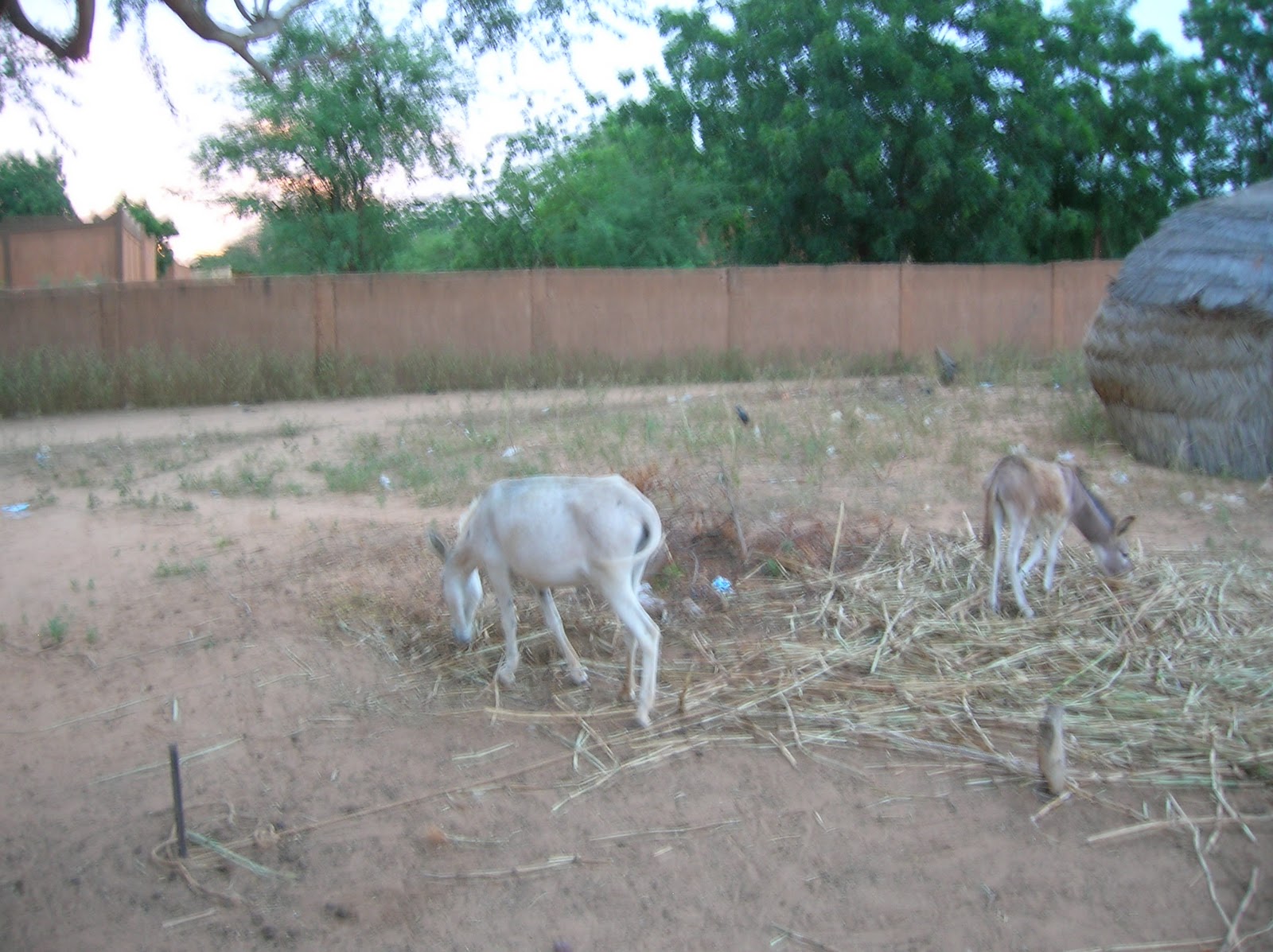
A horribly blurred picture of our host family's donkeys (jaki in Hausa)

Sorry for the blurriness, we haven't used our nice camera at all yet... this is where we slept for all of PST... under the stars :)

Easily the biggest tree we've seen in Niger so far and its in our host family's gida (Hausa for household)!!

We had class (not together) in our host family's gida with one or two other trainees and a language teacher. From left to right: Chelsea, Michael, and Aschaitou

Us !!

Our host dad, Isoufou, took us out to his field on the donkey cart!!

This is when we were on demyst... walking for an hour and a half to get to the market town almost right on the border with Nigeria.

Thank goodness for ox carts!!!

The entire village of Hamdallaye gathered for prayer on the first morning of Tabaski, a major Muslim celebration.

Our entire host family, including extended relatives on our dad's side.

It is tradition to slaughter sheep after morning prayer on Tabaski, then they skin, and gut them, then cook them like this, slowly and all day close to a very hot fire.

Our host family had a pregnant cat who gave birth about 6 weeks ago, and this is the one we're taking with us to our post!! Sunanshi Charlie (his name is Charlie!!)

Ash and I at the hostel in the city of Maradi...

We had a cultural fashion show in which Ash and I dressed up in traditional Tuareg outfits...
 |
| Me posing for the camera in my tailor-made traditional outfit called a Jabba... so comfy!! |
 |
| Blake and Elisa, thank you SO MUCH for the French press... we have gone through about a pound of coffee during PST... |
Tuesday, December 28, 2010
new address!
Hello all!!
We have our new address for the next two years!! And for those of you who have asked about what to send we will always welcome things like granola, organic dried fruit, and nuts!! :D but, we also look forward to letters! Or any source of news - newsweek, time, the economist, national geographic, major newspapers (would be awesome! - says jos) :) I am also a fan of real simple, just a thought :)
Just a reminder that we have to pay on this end for whatever the value says on the packages. So please be conservative with the estimates... Wink wink ;)
Love to all!!!
Here's the address:
Corps de la Paix
BP 144
Dosso, Niger
Surprise!! it's a mini blog within a blog!! :) (it's called having limited access to internet) haha
Anyway...
We passed our final language exams and will officially be able to swear-in as volunteers on the 30th!! So excited! :) (just for the record Jos rocked his LPI and got to "intermediate high" and i made it in with "intermediate mid") :D
Life is grand!!
Missing you all bunches and we hope you are having a relaxing and fulfilling holiday season... take cares!
We have our new address for the next two years!! And for those of you who have asked about what to send we will always welcome things like granola, organic dried fruit, and nuts!! :D but, we also look forward to letters! Or any source of news - newsweek, time, the economist, national geographic, major newspapers (would be awesome! - says jos) :) I am also a fan of real simple, just a thought :)
Just a reminder that we have to pay on this end for whatever the value says on the packages. So please be conservative with the estimates... Wink wink ;)
Love to all!!!
Here's the address:
Corps de la Paix
BP 144
Dosso, Niger
Surprise!! it's a mini blog within a blog!! :) (it's called having limited access to internet) haha
Anyway...
We passed our final language exams and will officially be able to swear-in as volunteers on the 30th!! So excited! :) (just for the record Jos rocked his LPI and got to "intermediate high" and i made it in with "intermediate mid") :D
Life is grand!!
Missing you all bunches and we hope you are having a relaxing and fulfilling holiday season... take cares!
Subscribe to:
Posts (Atom)